Bulk Cryogenic Tanks for Sale

Bulk cryogenic tanks for continuous industrial gas supply, new and used inventory in capacities from 1,500 to 11,000+ gallons, sized to your daily consumption, peak demand, and refill economics.

THEPROBLEMWITHBUYINGBULKTANKSOUTRIGH

What Is a Bulk Cryogenic Tank?

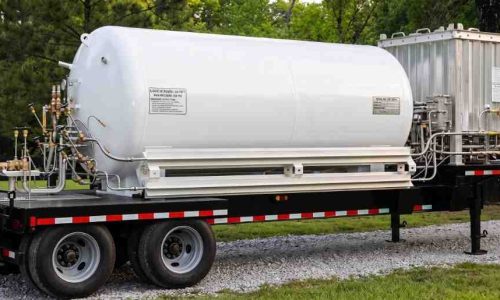
A bulk cryogenic tank is a stationary, vacuum-insulated pressure vessel designed to store large volumes of liquefied industrial gas, most often liquid oxygen (LOX), liquid nitrogen (LIN), liquid argon (LAR), or liquid CO₂, and deliver it as gas to a facility’s process equipment. 

The tank itself is two vessels in one: a stainless steel inner vessel that holds the cryogen, a carbon steel outer jacket, and a high-vacuum space packed with multilayer insulation between them. That construction is what lets a bulk tank hold liquid nitrogen at roughly -320°F for weeks at a time with minimal boil-off.

A complete bulk cryogenic storage system isn’t just the tank. It’s the tank plus a vaporizer that converts the liquid into usable gas, a pressure-building circuit that keeps tank pressure stable under draw, a final-line regulator package that delivers gas at process pressure, and the piping in between. Buying a bulk tank without considering the rest of the system is one of the most common and expensive mistakes we see.

When Bulk Storage Makes Sense

Bulk isn’t always the right answer. Here’s when it is.

Continuous production demand.

If your process runs gas around the clock — laser cutting, IQF freezing, MAP packaging, food-grade CO₂, semiconductor blanketing cylinders, and high-pressure dewars — it stops making economic sense fast. Bulk gives you a steady supply without the labor of cylinder swaps and the downtime risk of running out mid-shift.

High-volume gas consumption

The crossover from cylinders or microbulk to bulk usually occurs somewhere between 50,000 and 100,000 SCF per month, depending on your gas supplier’s pricing and your refill access. Above that, the per-cubic-foot cost of bulk supply is materially lower.

Reduced refill frequency

Properly sized, a bulk tank should be refilled every 2 to 4 weeks under normal demand. That cadence gives you delivery flexibility, lets you run fewer trucks through the gate, and reduces the operational drag of supply logistics. Every refill is a scheduling event; fewer events mean fewer chances for something to go wrong.

Centralized supply

 When you have multiple points of use across a facility — labs, production lines, fill stations — one bulk tank with a properly engineered piping network is almost always cheaper to operate than maintaining cylinder packs at each location. You also get one pressure source, which simplifies process control.

Common Industries

Where bulk cryogenic tanks for sale typically end up:

Request bulk tank availability and sizing

Tell us your gas, daily consumption, peak demand, and project location. We’ll come back within 24 hours with what we have, what we can source, and a system that’s actually sized for what you’re doing.

How to Size a Bulk Cryogenic Tank

Sizing is where most bulk tank decisions go right or wrong. Here’s the framework we walk every buyer through.

Small bulk (1,500 to 3,000 gallons) for mid-size facilities, smaller fill plants, and satellite locations

Mid-range bulk (3,000 to 6,000 gallons) — the workhorse range for most distributor and manufacturing installations

High-capacity bulk (6,000 to 11,000+ gallons) for large industrial users, primary fill plants, and high-consumption food and chemical processors

CO₂ bulk sized in tons rather than gallons, typical inventory runs 6, 14, 30, and 50-ton vertical units with vacuum-jacketed construction

Available Capacity Options

Why Buyers Choose FireCryo

We’re a 50-year-old family-run cryogenic shop, not a marketplace and not a single-brand reseller. That changes how we sell tanks.

Multi-manufacturer sourcing

We work across Chart, MVE, Taylor-Wharton, Cryenco, CryoQuip, and others. Some sellers in this space are locked into one brand, fine if that's the brand you want, limiting if it isn't. We match the tank to the application, not the application to whatever's on our floor.

System sizing, not just tank quoting

When you call, you'll get someone who actually knows cryogenic systems. Julie McFarlane started as a vacuum technician 40 years ago and has been spec'ing systems since the early '90s. We'll work through your gas flow rate, downstream pressure, and footprint before quoting equipment. That conversation is free; the wrong tank isn't.

Network depth on the hard sources

We get calls every week for tank sizes, manufacturers, or configurations that no one else can locate. Decades of dealer relationships are what make that possible. If a bulk tank exists in North America that meets your needs, there's a good chance we can find it.

Quotes back in 24 hours

Tell us what you need, and you'll have pricing and options the next day.

FREQUENTLY ASKED QUESTIONS

It depends on size, condition (new vs. used), manufacturer, working pressure, and whether you need ancillary equipment, such as a vaporizer or a final-line package. A used 6,000-gallon bulk tank can cost a fraction of a new tank of the same size with full system integration.

Microbulk tanks are typically 500 to 1,500 gallons and are designed for lower-volume continuous demand. Bulk tanks start around 1,500 gallons and scale up from there. 

You can, but it’s rare that you should. The tank, vaporizer, PB circuit, and regulators only work as a system. If you have existing ancillary equipment that’s compatible, fine. If you’re building from scratch, we’ll quote the full system because that’s the only way the numbers work out cleanly.

For tanks already in our yard, freight scheduling is usually the only variable; most domestic shipments move within one to three weeks. Sourced tanks (the ones we find through our network) take longer, depending on origin and any prep work needed. New tanks from manufacturers are on factory lead times, which vary with demand.

Tank installation typically requires a structural pad, foundation work, and coordination with the gas supplier for the fill connection. We can advise on installation requirements at quote time and help connect you with field service partners. Many bulk tank buyers also lease. See our Equipment Leasing options if buying isn’t the right fit.